
2025 Corvette ZR1: 1,064 HP and a 233-MPH Top Speed
The 233-MPH Corvette ZR1: How
America Built a 1,064-HP Hypercar Slayer for One-Third the Price
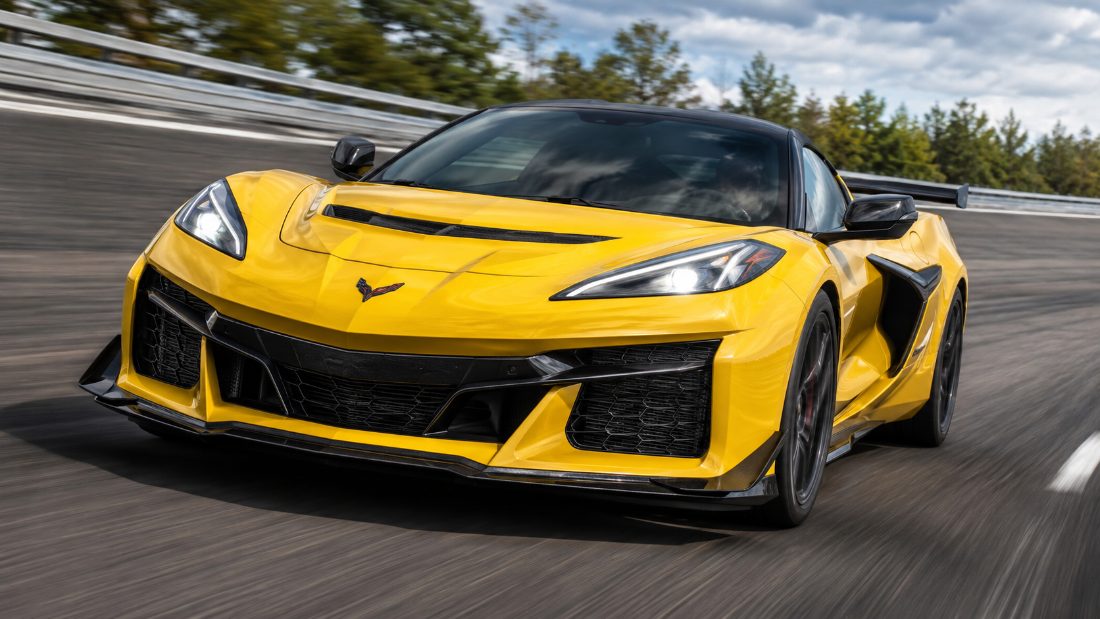
At precisely
233.5 miles per hour, the dashed white line on a closed German oval doesn't
look like paint anymore. It looks like a solid beam of light burning under your
tires. Every joint in the asphalt sounds like a rifle crack, and the air around
the car is compressed into a solid, punishing wall of aerodynamic drag.
Most
automakers treat that kind of speed as an existential engineering crisis. They strip
out passenger seats, install bespoke one-off race tires, fit prototype
transmissions, and recruit Formula 1 drivers to sign life insurance waivers.
General
Motors did something very different at the ATP testing facility in Papenburg,
Germany.
GM President
Mark Reuss climbed into a bone-stock 2025 Corvette ZR1, shifted the dual-clutch
transmission into automatic Top Speed Mode, and set off with a development
engineer sitting right beside him in the passenger seat, calmly reading
telemetry off a laptop. Minutes later, the speedometer flashed 233 mph in sixth
gear, redlining against the mechanical limits of an American V8.
The C8
Corvette ZR1 isn't just the fastest production car ever built by an American
automaker. It is a calculated, unhinged middle finger to the European hypercar
establishment.
Under the Rear Glass: Meet the Twin-Turbo LT7
To
understand how a street-legal Corvette punches through the 230-mph barrier, you
have to look behind the driver's head.
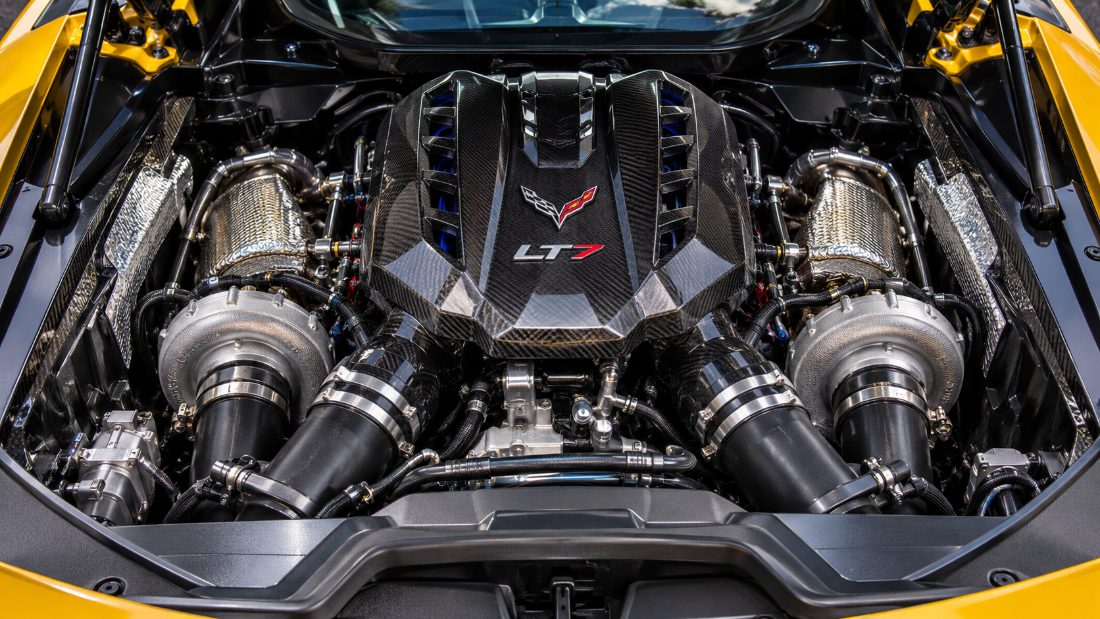
The ZR1
discards the supercharger setups of the C6 and C7 generations in favor of raw,
twin-turbocharged precision. Designated the LT7, the engine starts with
the bones of the Z06's naturally aspirated 5.5-liter flat-plane crank V8. But
converting a high-revving naturally aspirated engine to handle forced induction
required a near-total redesign.
The LT7
features a unique engine block casting with reinforced bulkheads, specialized
combustion chambers, CNC-machined cylinder heads, and thicker head gaskets to
handle massive cylinder pressures. Bolted directly to the custom exhaust
manifolds are dual 76mm BorgWarner mono-scroll turbochargers—some of the
largest turbine units ever installed on a production road car.
The output
numbers read like fiction:
- Horsepower: 1,064 hp @ 7,000 rpm
- Torque: 828 lb-ft @ 6,000 rpm
- Redline: 8,000 rpm
What makes
this powertrain historic is what is missing: There are no electric motors,
no heavy battery packs, and no front-axle hybrid assists.
While
Ferrari (SF90 Stradale) and McLaren (W1) rely on complex multi-motor hybrid
architectures to cross the four-figure horsepower mark, Chevrolet engineers
achieved 1,064 hp purely through air, fuel, and mechanical timing. All 1,064
horses flow exclusively to the 345-width rear tires.
Taming Giant Turbos: 16 Injectors and Smart Anti-Lag
Large
turbochargers usually come with an intolerable vice: turbo lag. If you slap
twin 76mm compressors on a V8, you normally wait what feels like an eternity
for the exhaust gases to spool the turbines before the boost hits.
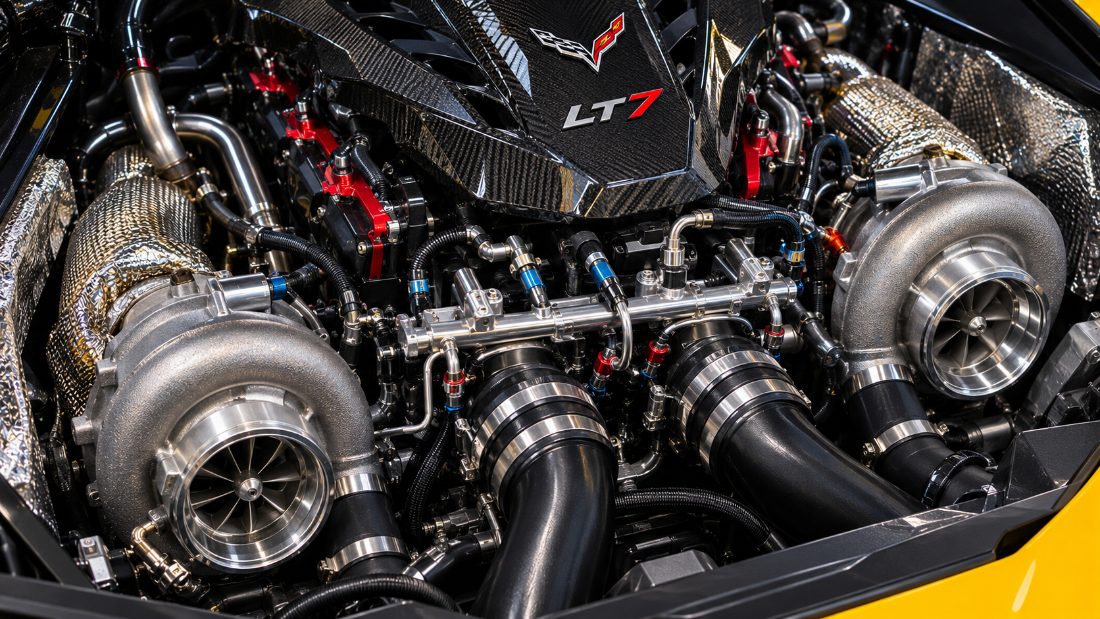
To eliminate
this delay without melting the exhaust valves, GM implemented a sophisticated
dual-fuel delivery system and proprietary anti-lag calibration:
- Dual Fuel Injection (16
Injectors): The
LT7 employs both direct injection (spraying fuel directly into the
cylinders at over 5,000 psi) and port injection (spraying fuel into the
intake runners). When cruising, it sips fuel efficiently. When you demand
all 1,064 horsepower, all 16 injectors open up to drown the cylinders in
high-octane mist.
- Dynamic Anti-Lag Calibration: When the driver lifts off the
throttle entering a corner on a racetrack, the engine management system
doesn't shut down. Instead, it precisely modulates the electronic
wastegates and throttle blade, maintaining up to 7 psi of residual intake
boost and keeping the heavy turbine wheels spinning at tens of thousands
of rpm. The split-second your foot touches the accelerator on corner exit,
full power is instantaneous.
The Aero Paradox: Why the Big-Wing Package Is Slower
One look at
the Corvette ZR1 configurator reveals two radically different visual
personalities: the standard car and the track-ready ZTK Performance Package.

The ZTK
package is an aerodynamic weapon. It bolts on a gargantuan high-mounted rear
wing, front dive planes, and a tall hood Gurney lip that generate over 1,200
pounds of downforce at top speed. It is engineered to set blistering lap
times at Road America and the Nürburgring by gluing the tires to the asphalt.
Here is the
paradox: If you want to go 233 mph, you must avoid the ZTK wing.
Downforce is
the mathematical enemy of terminal velocity. Generating 1,200 pounds of
vertical load creates immense induced drag—acting like a parachute at
triple-digit speeds. With the ZTK package fitted, aerodynamic drag caps the
ZR1's top speed at roughly 215 mph.
To achieve
the historic 233-mph run, GM used the standard aero configuration: a
subtle carbon-fiber front splitter, sleek carbon ground effects, and a
low-profile rear spoiler fitted with a short wickerbill. Riding on standard
Michelin Pilot Sport 4S street tires, this low-drag profile allowed the ZR1 to
knife through the German air like a missile.
The Return of the Split Window: Form Follows Heat
For the
first time since the legendary 1963 C2 Sting Ray, Chevrolet has brought back
the iconic split rear window.
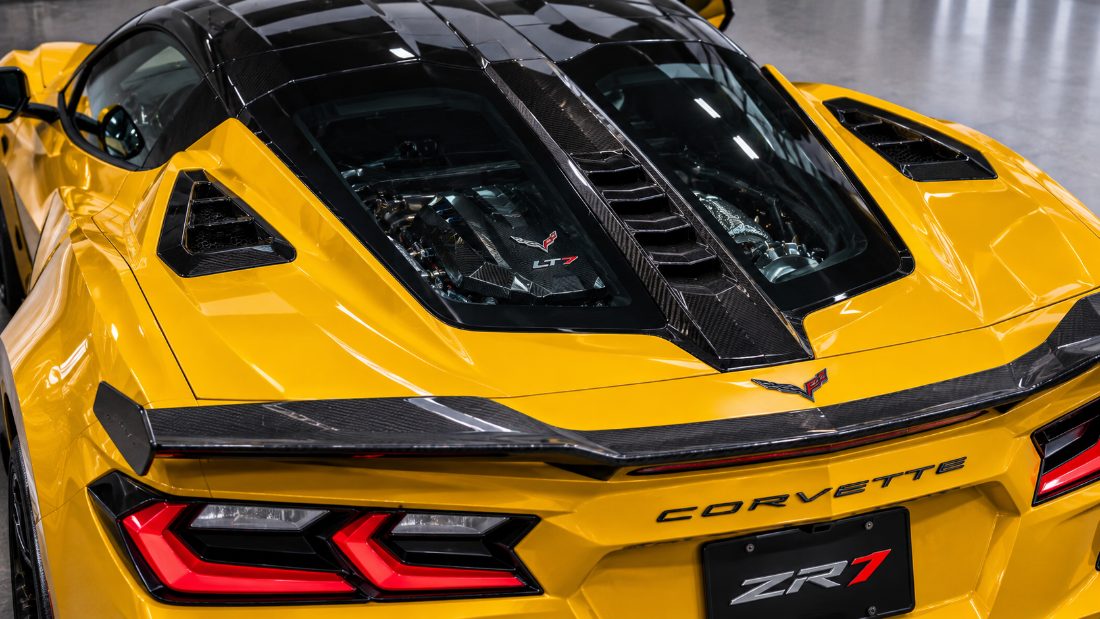
Purists
celebrated the styling homage, but Corvette Chief Engineer Tadge Juechter and
his team didn't resurrect the split window for nostalgia. They did it because
the LT7 was cooking itself in early prototype testing.
Cramming
twin 76mm turbochargers into a tight mid-engine compartment creates
catastrophic thermal loads. Radiators in the front nose can cool the water, but
trapping stagnant, superheated air around the exhaust manifolds melts wiring
harnesses and structural composites.
The
carbon-fiber spine that divides the rear glass is a hollow, functional heat
extractor. As the ZR1 accelerates, low air pressure over the rear deck lid
creates a vacuum effect, violently pulling hot air out of the engine
compartment through the center spine vents. It is vintage design pressed into
the service of thermodynamics.
How It Stacks Up Against European Exotics
The
automotive industry has quietly entered an era where European supercars have
become unobtainable status symbols costing half a million dollars. The ZR1
shatters that pricing bubble with blue-collar brutality.
|
Metric |
C8 Corvette ZR1 |
Ferrari SF90 Stradale |
McLaren 750S |
Porsche 911 GT3 RS |
|
Base Price
(Est.) |
~$150,000
– $180,000 |
$528,000+ |
$330,000+ |
$241,300+
(Plus Dealer Markup) |
|
Powertrain |
5.5L
Twin-Turbo V8 |
4.0L TT V8
+ 3 Electric Motors |
4.0L
Twin-Turbo V8 |
4.0L
Naturally Aspirated Flat-6 |
|
Horsepower |
1,064 HP |
986 HP |
740 HP |
518 HP |
|
Torque |
828 lb-ft |
590 lb-ft |
590 lb-ft |
342 lb-ft |
|
Verified
Top Speed |
233 MPH |
211 MPH |
206 MPH |
184 MPH |
|
Drivetrain |
RWD |
AWD
(Hybrid) |
RWD |
RWD |

Think about
those numbers. The Corvette ZR1 offers 1,064 horsepower for less than
half the starting price of a McLaren 750S, and nearly one-third the price of an
entry-level Ferrari hybrid—while boasting a top speed that comfortably outpaces
both.
The Reality Check: What Buyers Must Understand
As
magnificent as 233 mph sounds on YouTube, buyers waiting in line at Chevy
dealerships need a cold dose of perspective.
First, putting
1,064 horsepower down through the rear wheels alone requires absolute respect.
Unlike the all-wheel-drive Corvette E-Ray, which launches out of wet
intersections like a slot car, the ZR1 will liquefy its rear Michelin tires if
you turn traction control off with cold rubber. In sub-60-degree weather,
full-throttle applications below 60 mph will challenge your instincts.
Second, the
heat management is real. While the split window and side intakes keep the
engine running, the rear trunk (trunk behind the engine bay) will get hot
enough to soften luggage and melt chocolate. This is not a grand tourer; it is
a thinly disguised GT3-class race car with air conditioning.
Finally,
dealer markups will be predatory. Expect initial allocations to see $50,000 to $100,000
dealership gouging before sanity returns to the market.
VehicleDrugs Editorial Verdict
We are
living through the sunset of pure, unadulterated internal combustion.
Government regulations, corporate electrification mandates, and sound
restrictions are systematically squeezing mechanical drama out of modern
performance cars.
The C8
Corvette ZR1 is General Motors' defiant response to that creeping silence.
By building
a 1,064-horsepower, flat-plane crank twin-turbo monster with no hybrid
crutches, no synthetic exhaust speakers, and a verified 233-mph top speed,
Chevrolet proved that the pinnacle of sports car engineering doesn't belong
exclusively to Italian ateliers or German skunkworks.
It belongs
to Bowling Green, Kentucky.
Frequently Asked Questions
What is the official top speed of the C8 Corvette ZR1?
The official
verified top speed of the C8 Corvette ZR1 is 233 mph (375 km/h). This
record was set at the ATP test facility in Papenburg, Germany, piloted by GM
President Mark Reuss on standard low-drag aerodynamics and Michelin Pilot Sport
4S tires.
Is the Corvette ZR1 a hybrid?
No. Unlike
the Corvette E-Ray, the ZR1 does not use any electric motors or battery packs.
It is powered solely by a 5.5-liter twin-turbocharged flat-plane crank LT7 V8
engine sending all 1,064 horsepower to the rear wheels.
Why is the standard Corvette ZR1 faster than the ZTK
track package?
The ZTK
package includes a large carbon-fiber rear wing and front dive planes that
generate over 1,200 pounds of downforce. While this downforce improves
high-speed cornering grip on racetracks, it introduces significant aerodynamic
drag, which caps top speed at roughly 215 mph. The standard, low-drag spoiler
configuration allows the car to reach 233 mph.